



We often believe that our emotions are direct reactions to the events in our lives. If a friend doesn’t text back, we feel rejected. If we miss a deadline, we feel like a failure. However, psychological science suggests there is a hidden step between what happens to us and how we feel: our interpretation. This interpretation is where Cognitive Reframing lives. It is one of the most powerful tools in Cognitive Behavioural Therapy (CBT) and a cornerstone of self-belief improvement. By changing the “frame” through which we view a situation, we can fundamentally change our emotional response and our subsequent actions.
What is Cognitive Reframing?
At its core, cognitive reframing is the process of identifying and challenging irrational or maladaptive thoughts and replacing them with more accurate, constructive perspectives.
Imagine looking out a window at a landscape. If the glass is tinted dark blue, the world looks cold and gloomy. If you change that window for clear glass or a warm yellow tint, the same landscape suddenly looks inviting. The landscape (the event) didn’t change, but your experience of it did.

The Mechanism: The ABC Model
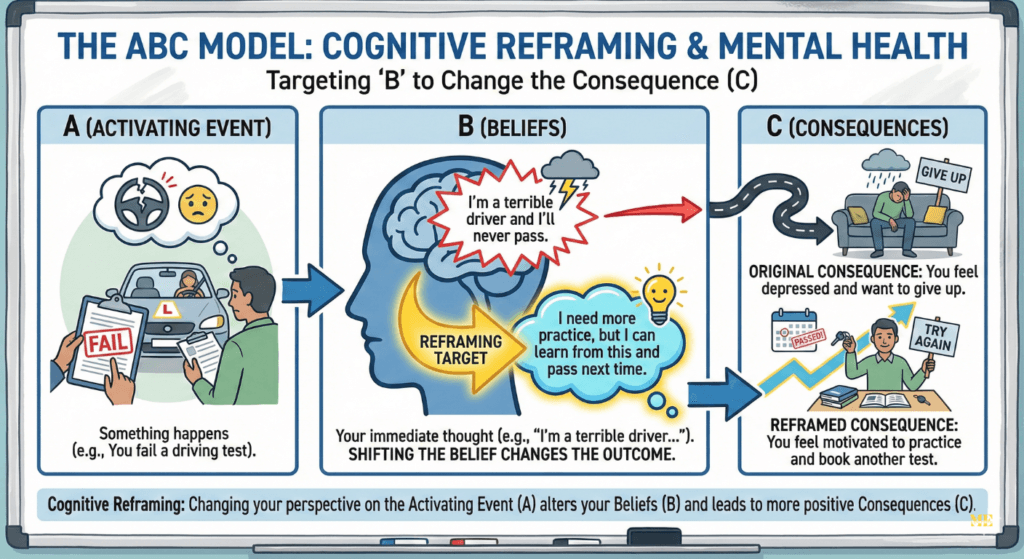
In mental health, reframing often follows the ABC Model:
- A (Activating Event): Something happens (e.g., you fail a driving test).
- B (Beliefs): Your immediate thought (e.g., “I’m a terrible driver and I’ll never pass”).
- C (Consequences): How you feel and act (e.g., you feel depressed and want to give up).
Reframing targets “B.” By shifting the belief, you change the consequence.
The Role of Cognitive Reframing in Mental Health
Cognitive reframing is a vital tool for managing anxiety, depression, and stress. It works by dismantling Cognitive Distortions—biased ways of thinking that maintain negative mindsets.
Common distortions include:
- All-or-Nothing Thinking: “If I’m not perfect, I’ve failed.”
- Catastrophising: “I made a mistake; now I’ll definitely get fired.”
- Mind Reading: “I just know they think I’m boring.”
When we use reframing, we act as a “mental detective.” We look for evidence that contradicts these distortions. Instead of accepting a negative thought as a fact, we treat it as a hypothesis that needs to be tested. This process reduces the intensity of negative emotions and prevents the “downward spiral” often associated with mental health struggles.
Boosting Self-Belief Through the “Power of Yet”
Self-belief is often stifled by a rigid internal narrative. When we tell ourselves, “I can’t do this,” we close the door to growth. Reframing allows us to move from a fixed mindset to a growth mindset.
One of the simplest yet most effective reframing techniques is adding the word “yet.”
- Original Thought: “I don’t know how to lead a team.”
- Reframed Thought: “I don’t know how to lead a team yet.”
This small shift changes a permanent character flaw into a temporary state of learning. It transforms a wall into a staircase. By consistently reframing challenges as opportunities for skill acquisition, you build a reservoir of self-belief that is resilient to temporary setbacks.
How to Practice Cognitive Reframing (A 3-Step Guide)
Reframing is a skill, not a personality trait. Like any muscle, it requires repetitive training.
STEP 1. Notice the “Hot Thought”
The first step is awareness. You can’t change a thought you don’t realise you’re having. When you feel a sudden drop in mood or a spike in anxiety, stop and ask: “What was I just telling myself?“
STEP 2. Challenge the Evidence
Ask yourself objective questions to poke holes in the negative frame:
- Is this thought 100% true?
- What would I tell a friend in this exact situation?
- Is there an alternative explanation for what happened?
STEP 3. Generate a “Neutral” or “Constructive” Frame
You don’t have to jump to extreme positivity. In fact, “neutral” reframing is often more believable and effective.
- Negative: “I’m a social disaster.”
- Neutral Reframe: “I felt awkward in that conversation, but I’ve had many successful conversations before. I can learn from this and try a different approach next time.”
Final Thoughts: Changing the Narrative
Cognitive reframing isn’t about lying to yourself or “toxic positivity”—it’s about intellectual honesty. It’s about acknowledging that our first, most emotional thought isn’t always the most accurate one.
By mastering this technique, you take the power away from your circumstances and place it back into your own hands. You realise that while you cannot always control what happens to you, you have the ultimate authority over what those events mean.
This post may contain affiliate links. As an Amazon Associate, we earn from qualifying purchases. See our Privacy Policy for details.